


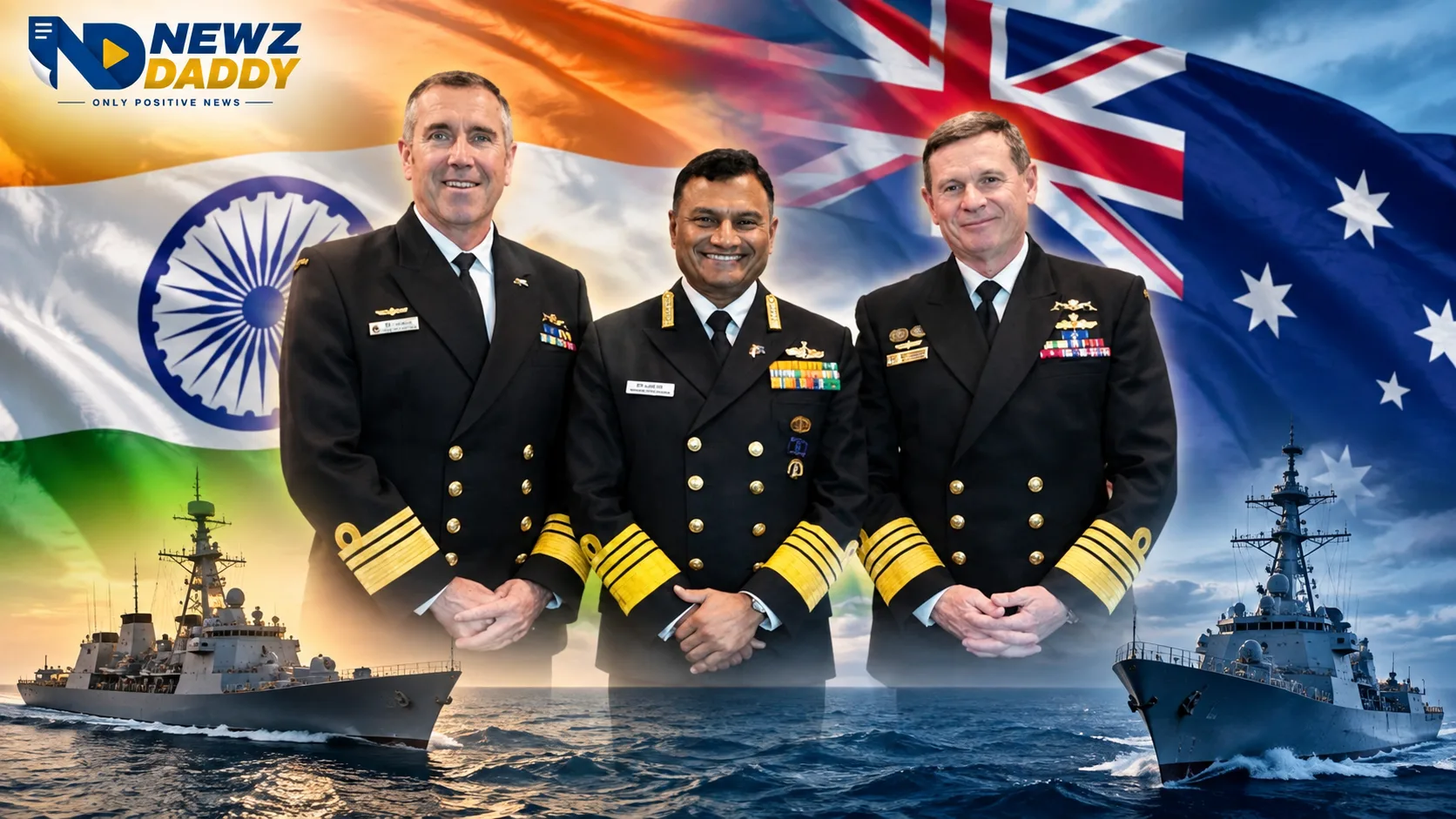
India-Australia Ties Deepen as Navy Chief Meets Hammond
India-Australia Naval Ties Gain Fresh Focus as Navy Chief Meets Australian Defence Chief in Canberra
Indian Navy Chief Admiral Krishna Swaminathan has met Australia’s Chief of the Defence Force, Admiral Mark Hammond, in Canberra as the two countries work to put their new maritime security commitments into practice.
The meeting took place during Admiral Swaminathan’s official visit to Australia and New Zealand. Talks with Admiral Hammond covered the implementation of the India-Australia Maritime Security Collaboration Roadmap, closer cooperation between the two navies and steps to improve their ability to operate together at sea.
The meeting comes two months after Prime Minister Narendra Modi visited Australia, where India and Australia agreed to strengthen defence and maritime cooperation. The two countries adopted the Maritime Security Collaboration Roadmap at the third India-Australia Annual Summit in Melbourne on 9 July 2026. The roadmap calls for greater information sharing, capability development, capacity building and operational coordination.
For India, the talks are important because Australia has become a regular partner in naval exercises, maritime surveillance and other activities in the Indian Ocean and wider Indo-Pacific. For Australia, India is an important partner in a region where shipping routes, undersea infrastructure and maritime trade are central to national security.
The latest meeting also carries added weight because Admiral Hammond became Australia’s Chief of the Defence Force in July 2026. Before taking the post, he served as Chief of Navy from 2022. The Australian government said his career in the Royal Australian Navy spans about four decades and includes service with frigates, submarines and the Australian Fleet.
Admiral Swaminathan became India’s Chief of the Naval Staff in May 2026. His Australia visit is therefore among his early senior-level engagements with a major maritime partner after taking charge.
The discussions in Canberra are part of a wider expansion in India-Australia defence ties. The relationship has moved steadily towards more frequent exercises, military exchanges and cooperation on maritime surveillance. Australian and Indian forces have also increased their work on maritime domain awareness, which involves collecting and sharing information about activity at sea.
The two countries have been building this cooperation for several years. At the 2021 India-Australia 2+2 Ministerial Dialogue, both governments agreed to strengthen maritime domain awareness and information sharing. Australia also placed a liaison officer at India’s Information Fusion Centre-Indian Ocean Region near New Delhi. The centre helps partners build a common picture of activity across the Indian Ocean.
By 2023, the relationship had expanded further. India and Australia agreed to continue aircraft deployments from each other’s territories and work on greater interoperability and information sharing. Australia also hosted Exercise Malabar for the first time, while an Indian Navy submarine, INS Vagir, made its first visit to Australia that year.
The pace of military activity has continued to rise. The Australian Defence Department said in April 2026 that India and Australia had more than tripled the frequency of their defence exercises, engagements and activities since 2014. During an Indian deployment in March, an Australian Navy helicopter operated from an Indian Navy aircraft carrier during Exercise Milan for the first time.
The maritime focus also reflects the geography of both countries. India sits at the centre of the Indian Ocean, while Australia has a long Indian Ocean coastline and major trade routes running through surrounding waters. Much of the trade of both countries depends on safe sea lanes.
Australian Defence Minister Richard Marles said in June 2026 that Australia and India share an ocean and described India as Australia’s main partner for maintaining peace and security in the Indian Ocean region. He also pointed to cooperation on freedom of navigation and the security of the seabed.
The two governments have also been working on maritime cooperation beyond their navies. The July 2026 summit welcomed a memorandum of understanding between Australia’s Maritime Border Command and the Indian Coast Guard. The arrangement is aimed at improving cooperation on civil maritime security.
Another area under discussion is the underwater domain. At the June 2026 Australia-India Defence Ministers’ Dialogue, the two sides agreed to advance maritime domain awareness work using maritime patrol aircraft and explore greater cooperation in undersea domain awareness. They also agreed to continue cooperation between the Indian Coast Guard and Australia’s Maritime Border Command.
The wider defence relationship received another boost in July when Prime Ministers Modi and Anthony Albanese issued a new Joint Declaration on Defence and Security Cooperation. It calls for stronger coordination, more complex military exercises and greater ability for the two forces to work together. The declaration also covers areas such as maritime security, defence industry cooperation, cyber security and technology.
For the Indian Navy and Royal Australian Navy, the next stage will depend on how these agreements translate into regular activity at sea. Information sharing, aircraft deployments, training and joint exercises can help personnel from both countries become more familiar with each other’s procedures and equipment.
That work is becoming more relevant as India, Australia and other Indo-Pacific countries face concerns over the safety of shipping routes and critical infrastructure. The Indian Ocean carries a large share of global energy and commercial traffic, making disruption at sea a concern well beyond the countries bordering the ocean. Australian officials have previously noted that the Indian Ocean carries about one-third of the world’s bulk cargo traffic and two-thirds of global oil shipments.
Admiral Swaminathan’s Canberra meeting therefore fits into a broader pattern that has developed over the past several years. The focus is now on making existing defence arrangements work in practical settings, particularly at sea.
The immediate task for both sides will be to maintain the pace of exercises, information exchange and operational contact while putting the Maritime Security Collaboration Roadmap into effect. The outcome will be closely watched as India and Australia continue to build their defence relationship around the Indian Ocean and the wider Indo-Pacific.