


Indian Coast Guard Medical Evacuation Saves Seafarer Off Porbandar
Indian Coast Guard Airlifts Sick Seafarer to Safety After Difficult Rescue Off Porbandar
A young seafarer who fell seriously ill aboard a merchant ship in the Arabian Sea was rescued by the Indian Coast Guard after a carefully planned medical evacuation off the coast of Porbandar in Gujarat. The operation, carried out on 26 July 2026, involved a Coast Guard patrol ship, an Advanced Light Helicopter (ALH), medical personnel and port authorities working together despite rough weather and challenging sea conditions.
The rescued crew member, aged 21, was serving onboard the merchant vessel MT Murlikisan when he developed severe chest pain and a high fever during the voyage. According to the Indian Coast Guard, the emergency began on the night of 25 July after the Maritime Rescue Coordination Centre (MRCC), Mumbai, alerted Coast Guard District Headquarters No. 1 (CGDHQ-1), Porbandar, about the sailor’s condition and the need for immediate medical care.
The Coast Guard quickly activated its Search and Rescue (SAR) response. However, rescuers faced a major obstacle. The weather and sea conditions made it unsafe to transfer the patient directly from the moving vessel in open waters, a method sometimes used during calmer conditions.
Instead, Coast Guard officers coordinated with the Porbandar Port authorities to allow the merchant vessel to enter the inner anchorage. By the forenoon of 26 July, the ship had anchored about 2.1 nautical miles from the breakwater, placing it closer to the shore while remaining at sea.
Even then, the rescue was far from straightforward. Port regulations and the rough conditions prevented the vessel from berthing at the Gujarat Maritime Board (GMB) Jetty. As the weather became more difficult later in the day, the Coast Guard decided that an aerial rescue offered the safest option.
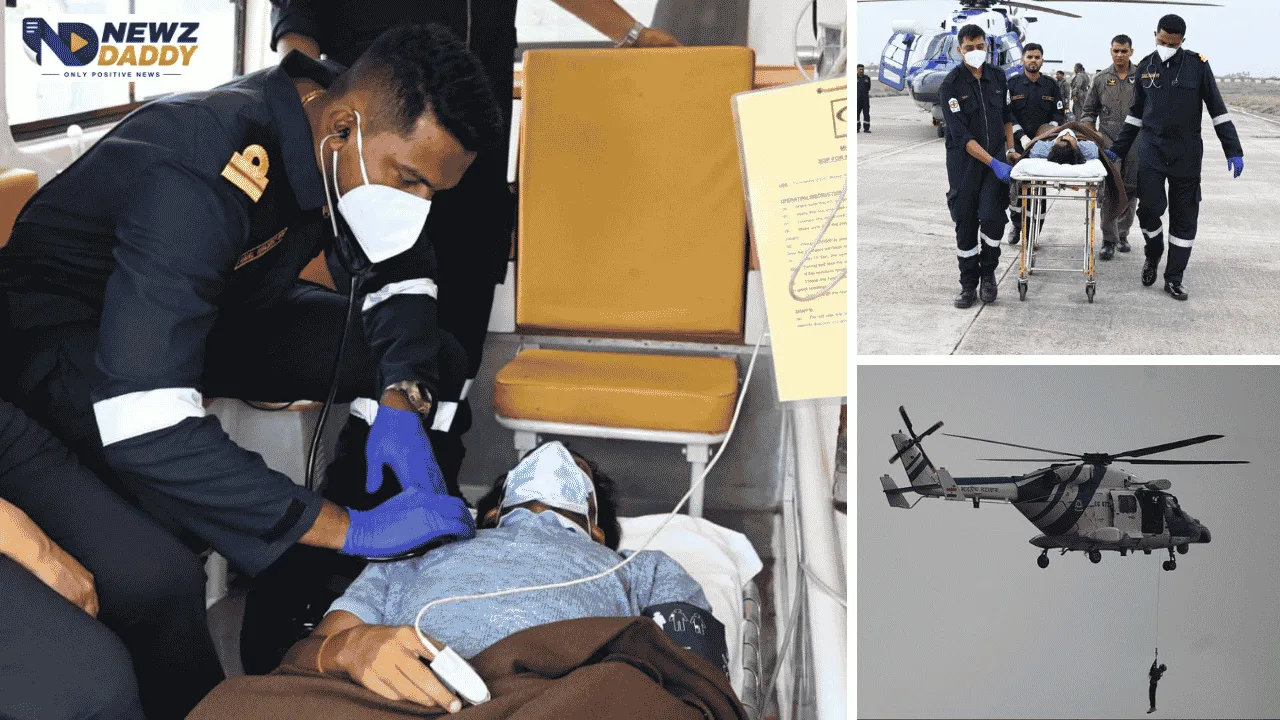
An Indian Coast Guard Advanced Light Helicopter was sent to the vessel. The helicopter crew successfully lifted the patient from the ship and transported him to the Coast Guard Air Enclave (CGAE), Porbandar, completing a demanding medical evacuation that required accurate flying and close coordination between air and surface units.
Soon after landing, the patient underwent an initial medical examination by an Indian Coast Guard Medical Officer. He was later shifted to Aasha Hospital, Porbandar, for specialised treatment. Officials said the patient was in a stable condition following the evacuation.
The operation reflected the Coast Guard’s motto, “Vayam Rakshamah” (“We Protect”), a phrase that appears on the service’s emblem and represents its responsibility to protect lives at sea.
Medical evacuation missions are among the most time-sensitive tasks handled by the Indian Coast Guard. Unlike routine search operations, MEDEVAC missions require rescuers to assess weather, sea state, vessel movement, aircraft safety and the patient’s medical condition before deciding on the safest course of action. Strong winds, high waves and poor visibility can make helicopter operations especially difficult, particularly when a ship cannot remain completely steady.
India has a coastline stretching more than 7,500 kilometres, with busy shipping routes linking ports on the Arabian Sea, the Bay of Bengal and the Indian Ocean. Thousands of cargo vessels, oil tankers, fishing boats and passenger ships travel through these waters every year. Medical emergencies at sea are not uncommon because ships can remain far from the nearest hospital for long periods.
The Indian Coast Guard, established in 1978, is responsible for maritime safety, search and rescue, marine environmental protection, anti-smuggling operations and assistance to vessels in distress. It works alongside the Indian Navy, port authorities, shipping companies and international rescue agencies whenever emergencies occur within India’s Search and Rescue Region.
The Maritime Rescue Coordination Centre, Mumbai, which initiated this operation, is one of the country’s key rescue coordination centres. It receives distress alerts from ships, aircraft and satellite-based emergency systems before directing Coast Guard assets or coordinating with other agencies to assist.
Porbandar plays an important role in India’s western maritime network. Besides being a commercial and fishing port, it serves as a strategic Coast Guard base because of its location along busy international shipping lanes in the Arabian Sea. The region frequently supports search and rescue operations involving merchant ships, fishing vessels and offshore activities.
Merchant ships such as MT Murlikisan usually carry multinational crews who spend weeks or even months at sea. Access to advanced medical facilities is limited once a vessel has sailed, making rapid coordination between shipping companies, rescue authorities and medical teams essential when a crew member becomes critically ill.
International maritime rules place a strong emphasis on protecting the health and safety of seafarers. Under global conventions adopted through the International Maritime Organisation (IMO) and the International Labour Organisation (ILO), ship operators are expected to ensure that crews receive appropriate medical assistance whenever serious illness or injury occurs. Coast Guard organisations around the world regularly work with merchant vessels to meet these obligations.
Although search and rescue missions often attract attention after cyclones, floods or maritime accidents, many Coast Guard deployments involve helping individual people facing medical emergencies far from shore. These operations demand quick decision-making, reliable communication and careful planning, especially when changing weather leaves only a short window for safe evacuation.
The successful rescue off Porbandar demonstrated how coordination between the Maritime Rescue Coordination Centre, Mumbai, Coast Guard District Headquarters No. 1, Coast Guard Ship Arush, the Advanced Light Helicopter, port authorities and medical teams enabled a seriously ill seafarer to receive hospital treatment without further delay. While challenging sea conditions complicated every stage of the mission, the patient reached medical care safely and was reported to be in stable condition after the evacuation.